From Wish List to Working Workflow: What We Presented at Future Proof Miami
When the team at Future Proof reached out months ago and asked whether we would help shape thought leadership content at what was shaping up to be the biggest AI-focused RIA conference to date, we were honored. We said yes without much deliberation.
But we were deliberate about what we would actually talk about. And the answer came, as it often does, from a client conversation.
We had been in an ideation session with Michael Tanney, CEO of Pereon Wealth. Michael is a rare combination: two decades advising high-net-worth families, a recent breakaway founder, and someone who thinks seriously about the future of the advisor-client relationship. In that session, the right topic for the stage became obvious.
Because what Michael kept running into, and what we kept running into alongside him, was a false choice. A narrative that had quietly taken hold in the wealth tech space that we thought needed to be challenged.
The False Narrative
Here is how the AI conversation tends to go for an RIA operator trying to stay at the forward edge right now.
On one side, there are the incumbent consultancies. They will build you a road map. It will be thorough. It will account for your data lake, your infrastructure, your long-term architecture. It will also take the better part of two years and a seven-figure budget before you have a single working AI workflow in production.
On the other side, there is the vendor map. And if you have spent any time looking at it lately, you know what it feels like. Hundreds of tools. Overlapping claims. A category in motion, where even the underlying model capabilities that power half these products, things like what Claude can do for financial services, are evolving faster than any product brochure can capture. It is a genuinely difficult landscape to navigate.
Neither option is a great answer for a firm that wants to move now, learn as they go, and build something that actually fits how they operate.
"Every RIA has an AI wish list. Almost none have a process for turning it into reality."
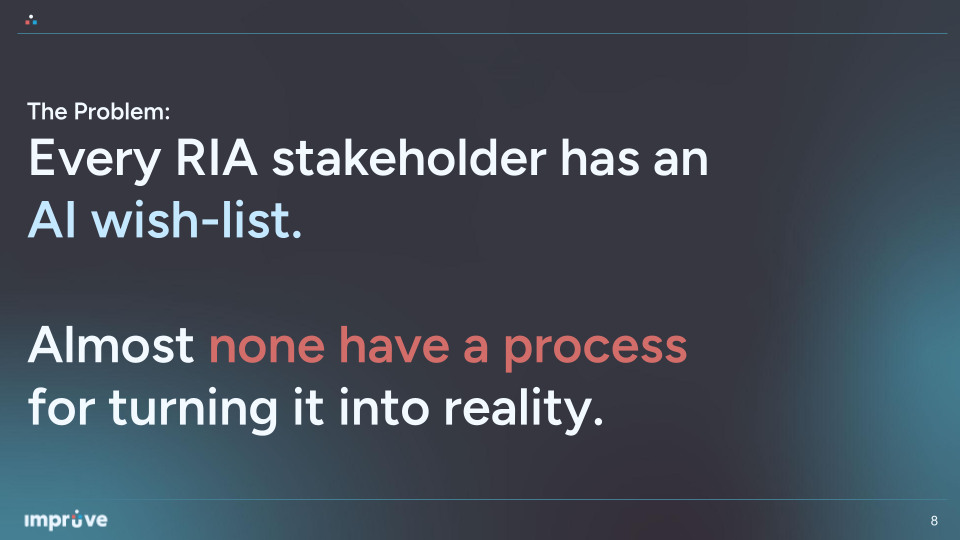
The core problem we opened with on stage at Future Proof Miami
The Impruve Approach: Concurrent Wins (Actionable Workflows + Data Infra)
What we have found, and what we wanted to demonstrate on stage, is that there is a third path. We call it the concurrent approach.
The traditional logic says: get your data in order first, then build. Clean the warehouse, structure everything, establish the infrastructure, and then, eventually, do AI. The problem is that sequence creates compounding delays. You are spending real capital on planning and cleanup before a single advisor has experienced a single improvement in how they work.
What we have seen work instead is this: start with a specific wish list item. Identify the desired outcome. Reverse-engineer the inputs. Build the workflow. Ship it in thirty days or fewer. Then let that first workflow inform where the data hygiene gaps actually are, in practice, not in theory.
Each small win funds and informs the next. Data quality improves through use, not through a pre-project cleanup sprint. And the firm starts building institutional confidence in what AI can actually do for them, not just what a slide deck promises it might do someday.
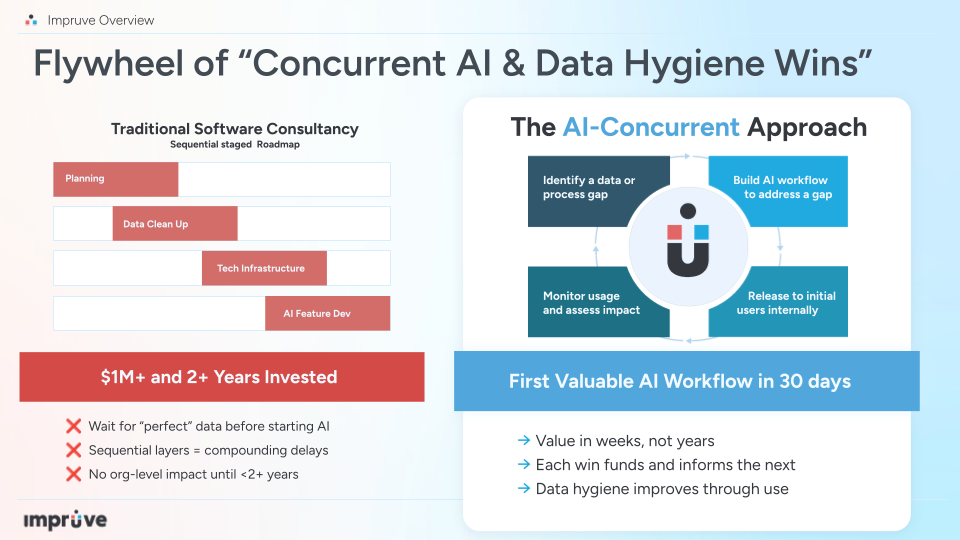
The flywheel we use to frame the concurrent approach versus the traditional sequential road map
The Simple-Yet-Revealing Example We Brought to the Stage
We wanted to show this process with a real example, one that came directly out of our work with Michael and Pereon. Not a theoretical use case. Something that actually happened.
Here is the wish list item Michael brought to us: every new client goes through a KYC process. That means collecting a driver's license. Those licenses sit in Egnyte, filed under client folders. There is an expiration date on every one of them. Nobody at the firm tracks it. The client eventually figures it out, usually later than they should.
Michael's question was simple: can we do something useful with the data that is already sitting there?
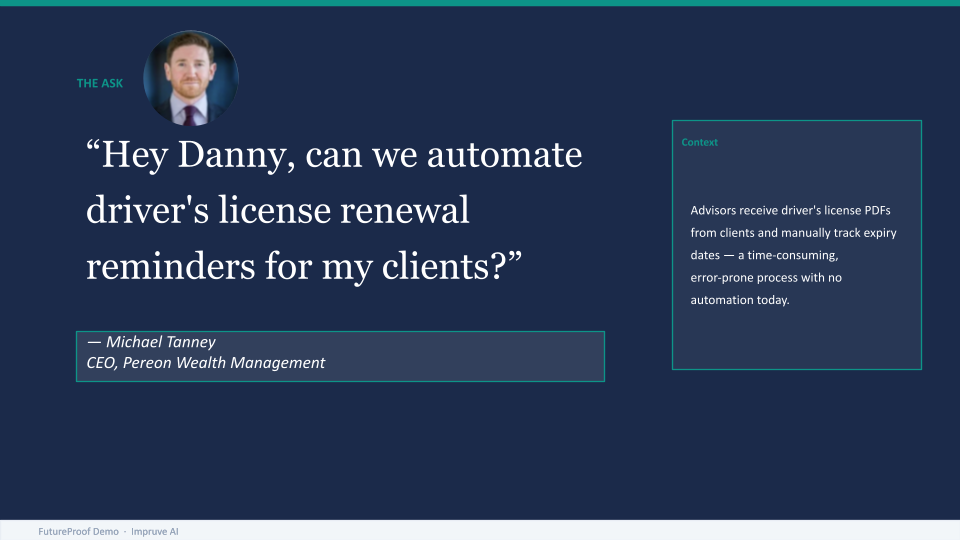
The original ask from Pereon Wealth CEO Michael Tanney that kicked off the workflow build
The goal we scoped together: when a client's license is within thirty days of expiry, they receive a personalized email, with nearby DMV locations and available times, sent automatically, with zero manual effort from the advisor.
Simple in concept. But worth walking through honestly, because the path from idea to working workflow always surfaces things you did not expect.
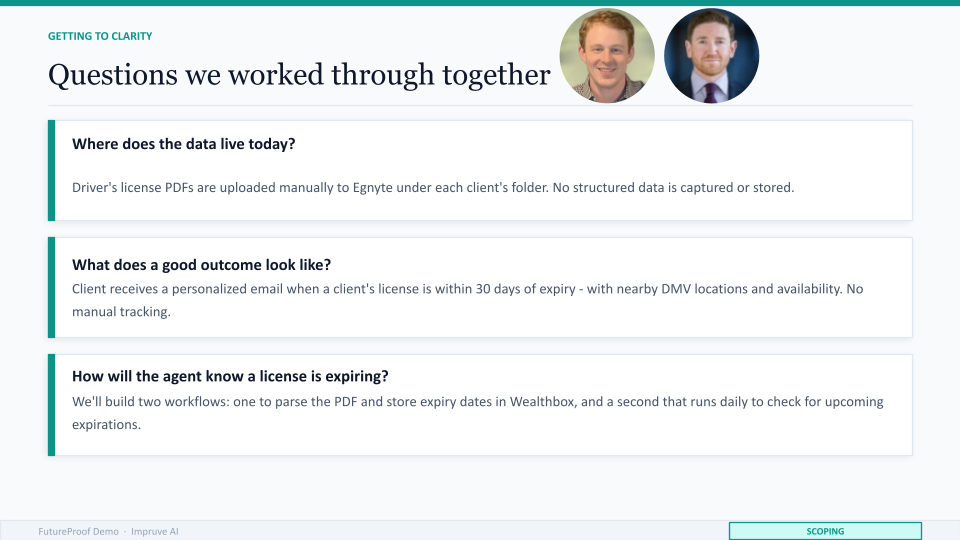
The scoping questions we worked through together before any code was written
What It Actually Takes to Build It
The first question we always ask is: where does the data live today? In this case, the licenses were stored as PDFs in Egnyte, filed under loosely named client folders. No expiration date was structured anywhere. No CRM field. No trigger.
That means before we could automate a reminder, we had to build the infrastructure to make the reminder possible. Two workflows, not one.
Workflow one: when a new license PDF arrives in Egnyte, the agent locates the document, extracts the relevant fields using OCR and an LLM, matches the client to their Wealthbox record, and writes the structured data back into the CRM. There is a confidence threshold built in. If the match is below 95 percent, it flags for human review rather than writing potentially bad data.
Workflow two: a daily automated check queries Wealthbox for any licenses expiring within thirty days. For each one, it looks up nearby DMV locations using the client's address, drafts a personalized email pulling from the client's CRM context, and sends it. If DMV availability data is unavailable (and DMVs are not exactly leading the charge on developer APIs), the email still sends with location information and a fallback link. If something is missing that would compromise the email entirely, the system flags it for the advisor rather than sending something incomplete.
That last point matters. The happy path is easy to build. The engineering question is always: what happens when something goes wrong? Every step in a workflow like this needs auditability. It needs graceful failure handling. An automated email going to the wrong client, or a CRM record getting updated incorrectly, is not a minor inconvenience. It’s a trust problem.
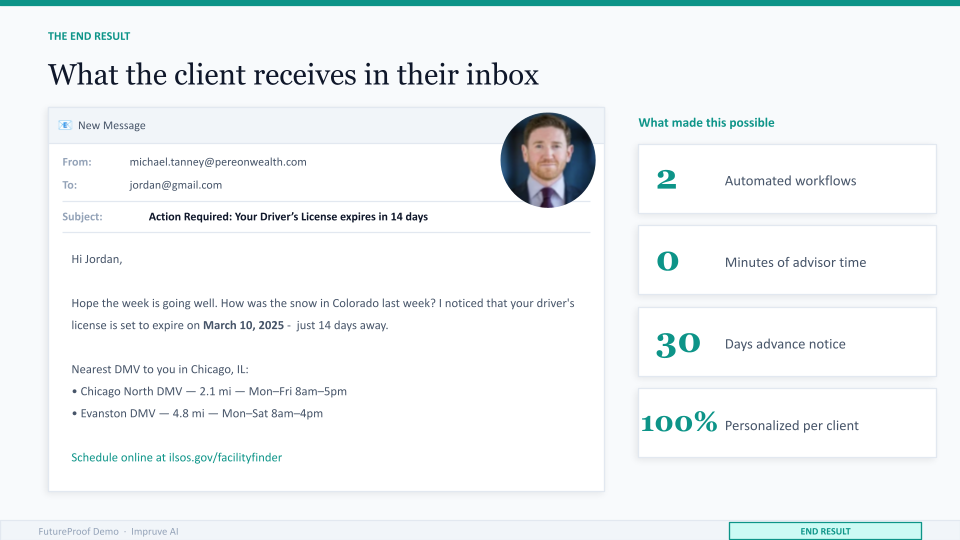
What the client actually receives in their inbox: zero minutes of advisor time, 100% personalized
The Data Problem We Concurrently Solved Along the Way
Here is the thing about this workflow that we think is more important than the workflow itself.
Before we built it, Michael's firm had license data. It just was not usable data. It was flat image files in a folder. It was not searchable. It was not triggerable. It was not connected to anything. It existed, technically, but it was functionally dead.
After workflow one ran, that same data became a structured asset. Expiration dates in Wealthbox. Addresses extracted and synced. A daily check running against clean, structured fields. And the same data that powers the license reminder can now power the next idea, whether that is an address change detection check, a beneficiary review prompt, or any number of downstream workflows that require knowing where clients live and when their documents are current.
We did not just build a workflow. We converted an existing but dormant data asset into something the whole practice can build on. That’s the flywheel in action.
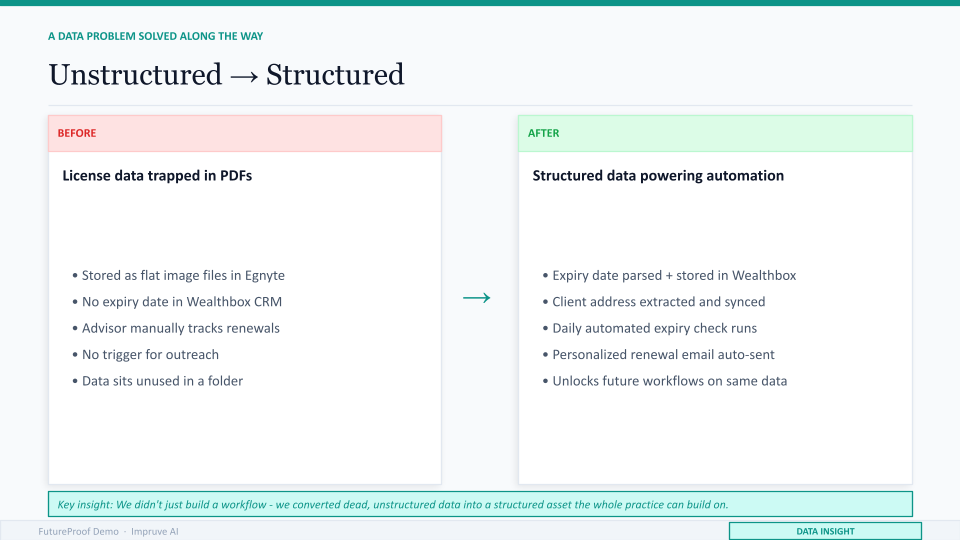
Unstructured to structured: the data shift that happened as a byproduct of the workflow build
The Live Q&A: Reverse Engineering a Wish List Item in Real Time
One of our favorite parts of the session was the open Q&A, where we invited the audience to offer their own wish list ideas and we walked through the engineering thinking live.
One attendee running a Black Diamond and Salesforce shop asked about building an agent they could query conversationally: give me a list of all my households above ten million dollars I have not spoken with in the last sixty days.
Danny's first question back was predictable to us but often surprising to advisors: what would you do today if you had the time to do it manually? Where is the data right now? The answer was Black Diamond. The workflow logic is straightforward. Get API access from Black Diamond, pull households by AUM, pull calendar and email data, run natural language processing on the indexed communication history, surface the result. Danny's assessment: probably buildable in a day once the API keys are in hand.
That is the point we kept returning to. The ask that feels technically daunting often has a relatively short path from idea to production. And if it does not, if you cannot build that workflow even in principle, it usually means somewhere in your stack you do not actually control your own data. Which is a problem worth knowing about now, before you are trying to build next-best-action intelligence on top of it a year from now.
Another Small Win Secured, Where Michael Tanney''s Mind Goes Next
Michael closed the session with a few of the ideas already forming for the next phase of build. A one-pager that shows a client, clearly and simply, how much tax savings the advisor's strategy has generated for them over time. A compounding value visualization that shows concretely what staying with the firm has been worth versus alternatives. A traffic light planning dashboard, green means things are on track, yellow means there is something to watch, red means we need to talk.
None of these are exotic. None of them require a complete data overhaul before you can start. All of them require knowing what data you already have, asking what outcome you actually want, and finding someone willing to reverse-engineer the path between those two things.
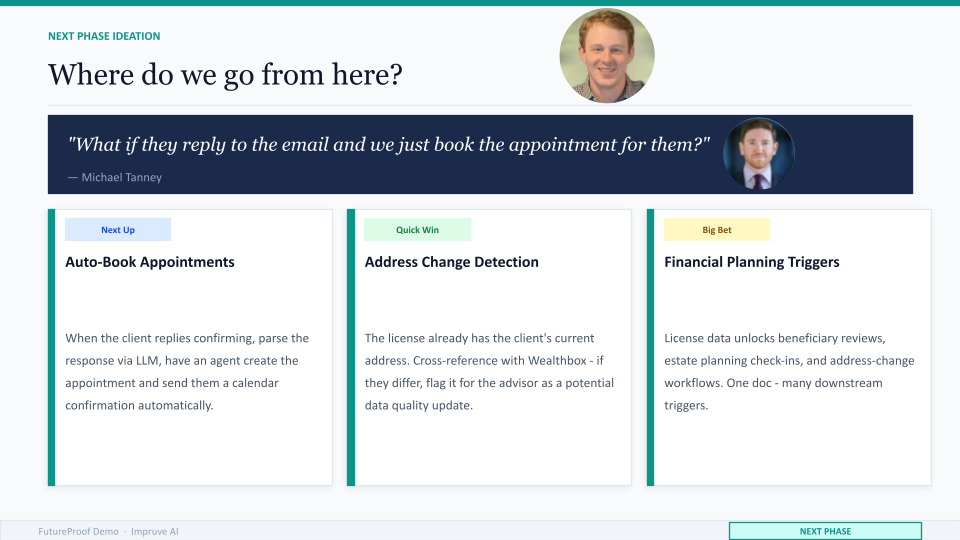
Next phase ideation: where one workflow leads to the next
"I'm not talking about making some fancy workflow using all the tools. Just what's something you're doing every day where you have data you're not actually using?"
- Michael Tanney, CEO, Pereon Wealth
What We Hope You Take Away
The conversation around AI in wealth management tends to oscillate between two modes: hype and paralysis. Either everything is about to change instantly, or the infrastructure problems are so large that no one should try anything until everything is perfect.
Neither is useful. What is useful is a small idea, a clear outcome, and a process for building toward it this month.
If you have a wish list item sitting in your head, whether it is a client communication you wish happened automatically, a report you cannot quite pull together cleanly, or a data point you collect but never actually use, that is the starting point. Not the data lake. Not the vendor evaluation. The idea.
We are grateful to Future Proof for the platform and to Michael Tanney for being the kind of client who thinks out loud and lets us build with him in public. We are even more grateful to the advisors in that room who took the Q&A seriously and shared what is actually on their wish lists.
That’s the whole spirit of what we do. That is AI Stewardship.